Global franchise brands need oven systems that deliver consistent crust, predictable throughput, simple training, and manageable maintenance across many countries. This guide explains how a Pizza Oven can be customized for different store sizes, service models, and menu formats without sacrificing standardization.A customizable Pizza Oven solution for global food service franchises should combine consistent heating, modular sizing, programmable controls, and easy cleaning access so each location can match local demand and utility conditions. In practical terms, franchises need ovens that fit a compact counter in one city, a high-volume kitchen in another, and a kiosk format in a third, while still producing the same product quality in 6 minutes to 12 minutes per cycle, depending on recipe and oven type. The best approach is to choose a platform with standardized operating logic, visible temperature feedback, and maintenance-friendly design. That matters because stores often face staffing variation, so a simpler system reduces training time and operating errors. It also matters because local power infrastructure can differ, so flexible electric configurations help brands adapt faster. For buyers comparing models, a useful starting point is the broader Pizza Oven product range, followed by closer review of a feature-specific model such as the easy-cleaning electric pizza maker with timer control and thermometer. In short, the right franchise solution is not just an oven; it is a repeatable cooking system built for scale in 2026 and beyond.
TL;DR
- Capacity planning: size ovens for peak demand, such as 30 pizzas per hour to 120 pizzas per hour, with a reserve margin of at least 15%.
- Thermal control: target stable chamber settings such as 250 °C to 450 °C, with repeatable timers from 3 minutes to 12 minutes.
- Footprint flexibility: choose units that fit counters from 60 cm to 180 cm wide, depending on store format.
- Cleaning efficiency: designs that cut end-of-day cleaning by 10 minutes to 25 minutes per shift can improve labor allocation.
- Rollout readiness: standard controls, spare parts planning, and local voltage matching can shorten site launch timelines by 2 weeks to 6 weeks.
Why global franchises need customizable oven platforms
Franchise operations expand into different real estate formats, from airport kiosks to mall food courts to street-front dine-in stores. A single fixed oven concept rarely works everywhere. A customizable platform works better because one location may have only 4 m² of back-of-house space while another has 18 m². One may need moderate throughput for lunch traffic, while another may need continuous evening output for delivery orders.
Customization does not mean uncontrolled variation. It means building around a common thermal and operational logic. You may vary chamber size, stack configuration, wattage, and user interface language, but preserve the same expected bake result. This is valuable because product inconsistency damages franchise trust, so standardization remains the center of the equipment strategy.
It also helps procurement teams. They can qualify one equipment family, create one training structure, and maintain one service philosophy across multiple regions. That matters because support complexity grows fast when every country uses a different oven type, so spare parts stocking and technician training become expensive.
Core customization points
- Chamber dimensions for different pizza diameters such as 25 cm, 30 cm, and 40 cm.
- Single-deck or multi-deck layouts for low-volume and high-volume stores.
- Power configurations aligned with local electrical standards.
- Timer programming for multiple recipes and service dayparts.
- Window visibility to support monitoring without heat loss.
- Cleaning access that reduces labor time per shift.
What franchise buyers should evaluate in a Pizza Oven
1. Throughput and recovery
A franchise oven should maintain steady output during peak periods of 60 minutes to 180 minutes. The key is not only how many pizzas fit inside at once, but also how quickly the chamber recovers after loading and unloading. Recovery speed matters because repeated door opening changes internal temperature, so weak recovery can lengthen bake times and reduce consistency.
2. Temperature precision
Temperature stability is one of the strongest predictors of repeatable crust development. Brands with signature textures need clear temperature displays, responsive controls, and credible thermometers. This matters because operators rely on visual and numeric feedback, so precise settings reduce guesswork across shifts.
3. User-friendly controls
Timer controls, indicator lights, and straightforward labeling help stores train faster. A visible workflow is especially important in markets with high labor turnover. Staff can perform better because the interface is intuitive, so managers spend fewer hours correcting avoidable errors.
4. Maintenance and sanitation
Easy-cleaning construction is not a minor detail. It affects labor planning, product quality, and machine uptime. If internal surfaces trap grease or crumbs, cleaning may require an extra 15 minutes to 30 minutes per shift. When the design is smoother and access is easier, turnaround improves.
5. Footprint and installation
Dimensions influence site selection and utility layout. A unit that performs well but exceeds a counter depth by 8 cm may force costly redesign. Franchises should review width, depth, height, door swing, service clearance, and cable routing before approving a rollout.
6. Visual merchandising value
A viewable window can support customer confidence and crew oversight. In open kitchens, seeing the bake process may enhance perceived freshness. This is helpful because visual cues reinforce operational rhythm, so teams are less likely to overbake or underbake during busy periods.
Why electric Pizza Oven solutions often fit global expansion
Electric models are often attractive for franchise growth because they simplify control and can align better with dense urban environments. In many markets, utility availability and building rules differ. Electric systems can be easier to standardize because heat output can be managed through set controls, so cross-border replication becomes more predictable.
They also support compact store concepts. A franchise may open in a shopping center, transport hub, or convenience-led format where space is limited. A well-designed electric Pizza Oven can offer strong output in a smaller footprint, especially when paired with smart timer use and disciplined loading procedures.
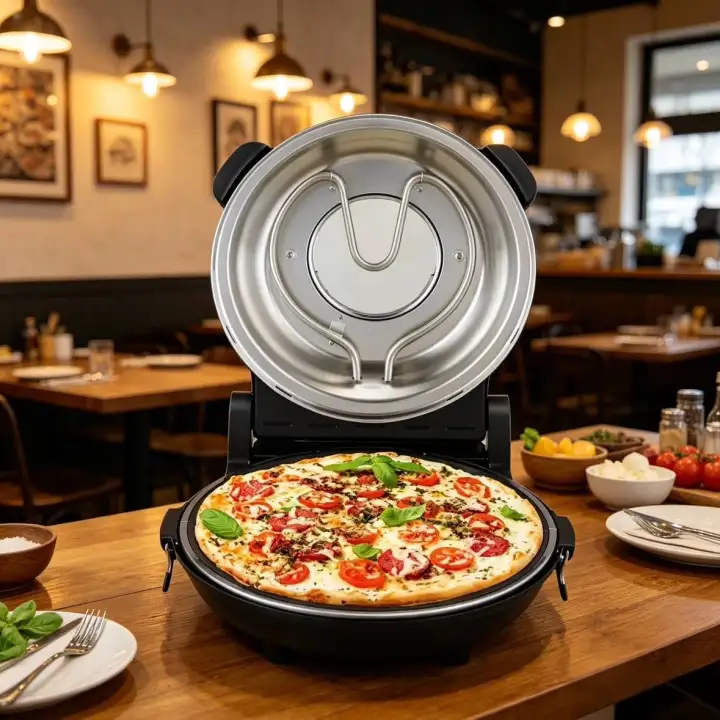
For operators interested in specific feature sets, the easy-cleaning electric pizza maker with timer control and thermometer illustrates several practical advantages: visible monitoring, simplified timing, and cleaning-oriented construction. Those features matter because crews need speed during rush periods, so every reduction in friction improves execution.
How to align oven customization with different franchise formats
| Franchise Format | Typical Demand | Recommended Focus | Useful Customization |
|---|---|---|---|
| Small kiosk under 12 m² | 20 pizzas per hour to 40 pizzas per hour | Compact footprint and easy operation | Single-deck oven, timer presets, front visibility window |
| Food court store at 20 m² to 40 m² | 40 pizzas per hour to 80 pizzas per hour | Balanced output and cleaning speed | Wider chamber, stronger recovery, removable crumb areas |
| Delivery-heavy branch over 50 m² | 80 pizzas per hour to 120 pizzas per hour | High throughput and durability | Stacked layout, programmable cycles, service access panels |
| Flagship dine-in store over 80 m² | 60 pizzas per hour to 100 pizzas per hour | Performance plus presentation | Windowed front, branded finish options, precise thermometer |
This alignment process prevents overbuying and underbuying. If a kiosk installs a high-capacity system it may waste energy and counter space. If a delivery branch installs an undersized oven, peak times become chaotic. Matching the format to the oven matters because traffic patterns shape load cycles, so the right configuration protects both service speed and food quality.
The role of easy cleaning in franchise profitability
Cleaning design deserves strategic attention. Franchise kitchens operate under time pressure, and small inefficiencies compound across dozens or hundreds of stores. If each location saves 12 minutes per day on oven cleaning, a network of 100 stores saves 1,200 minutes per day, or 20 hours per day. That is a meaningful operational gain.
Easy cleaning also supports food quality. Old crumbs and residue can affect heat flow and surface contact. Clean chambers perform more predictably because debris is reduced, so the bake environment remains more stable. In practical terms, smoother surfaces, fewer trap points, accessible corners, and removable parts all matter.
Training consistency across borders
A franchise may operate across languages, staffing models, and labor availability levels. Oven standardization helps training because crews can follow the same steps regardless of location, so launch teams can reuse training materials with only minor adaptation. This is especially helpful in 2026, when brands expect rapid rollout and shorter onboarding windows.
Important training-friendly features include clear thermostat readings, simple timer logic, visible windows, and predictable cleaning routines. When staff can see the product and trust the timer, they are less likely to interrupt the bake cycle. That matters because frequent opening releases heat, so the oven may need longer to recover.
For broader operational learning, franchise managers often reference food safety and training material from organizations such as ServSafe, NSF, and IFMA. These resources can complement internal SOPs when building staff routines around commercial cooking equipment.
Energy, safety, and facility planning
Any global rollout should include a site survey that reviews voltage, amperage, ventilation conditions, workflow paths, and cleaning access. Installation planning is not glamorous, but it prevents expensive surprises. A strong oven can fail operationally if its site cannot support safe placement, working clearance, or the required electrical load.
Franchises should also track public guidance and standards information from sources such as U.S. Department of Energy, U.S. Environmental Protection Agency, Occupational Safety and Health Administration, and ASHRAE. These references can inform discussions on ventilation, facility efficiency, and operator safety.
Because stores differ in utility quality and layout, a franchise should build a checklist before each deployment. This matters because equipment rollouts are often delayed by avoidable site mismatches, so a disciplined pre-installation review saves time and reduces rework.
Sample pre-installation checklist
- Counter width and depth measured in cm.
- Power supply compatibility verified before shipping.
- Operator working clearance of at least a practical service zone in front of the oven.
- Cleaning path confirmed for daily access.
- Ventilation conditions reviewed against local requirements.
- Test bake protocol prepared for first-day calibration.
Building a franchise specification that scales
The most useful equipment specification is clear enough for suppliers, technicians, trainers, and store managers to use without confusion. It should define output targets, pizza sizes, target bake times, chamber temperatures, acceptable recovery performance, cleaning tasks, and service intervals.
A scalable specification often includes three levels:
- Global standard: common bake profile, control logic, and quality target.
- Regional adaptation: electrical configuration, plug type, and labeling needs.
- Store-level fit: footprint, volume expectations, and workflow layout.
This layered approach works because franchise systems need both control and flexibility, so teams can preserve brand quality while adapting to local conditions. If you are reviewing broader options, the Pizza Oven collection is a practical place to compare platform possibilities before narrowing the specification.
How a feature-rich Pizza Oven supports menu innovation
Many franchise brands sell more than classic pizza. They may add flatbreads, baked snacks, reheated slices, dessert items, or region-specific products. A versatile Pizza Oven supports this strategy when it offers flexible timer settings, visible browning control, and stable thermal behavior. Menu expansion becomes easier because the oven can handle multiple recipes, so the brand gains revenue opportunities without adding many machines.
However, flexibility should be controlled. If a franchise adds too many recipes without disciplined programming, operators can become confused. The better approach is to develop a limited set of standardized bake programs with clear naming and target times such as 4 minutes, 7 minutes, and 10 minutes. This keeps the workflow simple while preserving menu range.
Frequently Asked Questions
1. What makes a Pizza Oven customizable for franchise use?
A customizable Pizza Oven for franchise use combines adjustable capacity, chamber dimensions, control logic, and maintenance access in one coherent platform. The goal is not random variation; it is controlled adaptation. A brand may need one oven width for a kiosk and another for a delivery store, but both should still produce the same crust and finish within the same time band, such as 6 minutes to 10 minutes. That is important because brand consistency drives customer trust, so customization must stay anchored to repeatable cooking performance.
2. How should franchises size oven capacity?
Capacity sizing should begin with peak-hour demand, not average daily demand. If a store expects 70 pizzas per hour during dinner and the oven can reliably produce only 50 pizzas per hour, service delays will appear immediately. Buyers should calculate order spikes, average bake time in minutes, loading losses, and an extra buffer of at least 15%. This matters because the real challenge is peak traffic, so capacity planning must be built around the busiest part of the day.
3. Why do electric Pizza Oven models suit international chains?
Electric models often suit international chains because they can offer cleaner control logic and easier standardization across regions. They are useful in urban environments where space is tight and facility limitations are common. They also simplify operator training because heat adjustment is usually straightforward, so crews can reproduce the same bake routine more reliably. For many brands, that predictability is more valuable than chasing equipment variety.
4. How important are timer controls and view windows?
Timer controls and view windows are highly practical features, especially in busy stores. Timers reduce dependence on memory, and windows let staff check progress without repeatedly opening the chamber. This matters because opening the oven too often releases heat, so temperature recovery becomes slower and product variation increases. In open-kitchen environments, windows can also improve customer confidence by making the baking process visible.
5. What cleaning features matter most?
The most useful cleaning features are smooth interior surfaces, accessible corners, removable debris areas, and layouts that reduce trapped crumbs or grease. Easy access lowers labor effort and speeds shift changeovers. That matters because kitchen teams often clean under time pressure, so a design that removes friction improves consistency. The feature-specific model at this product page is relevant for buyers prioritizing cleaning, timer control, and visible monitoring in one unit.
6. Can one Pizza Oven platform support different menus?
Yes, one platform can support multiple menus when the oven offers stable heat, flexible settings, and enough chamber space for the intended products. A franchise may prepare standard pizzas, flatbreads, snack items, or reheated portions with the same machine if programs are carefully defined. The key is discipline. Menu flexibility works because the oven can be programmed around distinct recipes, so the team gains range without losing control.
7. How can franchises reduce training time with oven standardization?
Franchises reduce training time by keeping controls, labels, cleaning steps, and troubleshooting routines consistent across markets. Operators learn faster when the interface looks familiar and the same timer logic applies in every location. This is especially valuable when opening multiple stores in a short period of 3 months to 9 months. Standardization helps because fewer operating differences mean fewer mistakes, so managers can focus on product execution rather than equipment confusion.
8. What should buyers review before a 2026 equipment rollout?
Before a 2026 rollout, buyers should verify electrical compatibility, footprint dimensions, operator clearance, cleaning workflow, spare parts planning, and local installation conditions. They should also run test bakes under realistic service demand and confirm that staff can follow the controls easily. This preparation matters because expansion schedules are often tight, so unresolved site issues can delay openings by 2 weeks to 6 weeks or more.
Post time: Apr-21-2026