Introduction
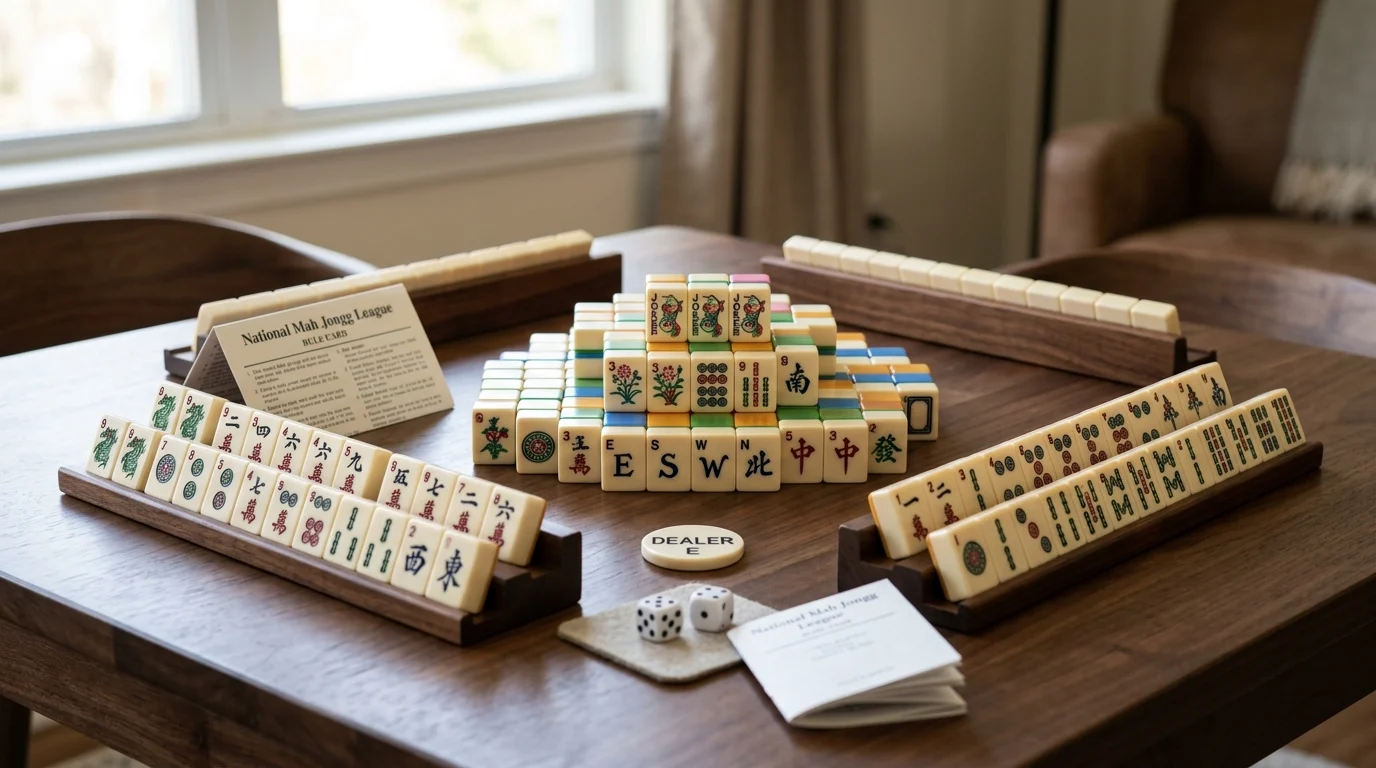
Retailers looking beyond standard tabletop inventory are finding strong potential in custom American Mahjong sets. As demand grows among younger, design-conscious shoppers, these products offer more than gameplay: they combine gift appeal, premium presentation, and brand differentiation in a single category. This article explains why customized sets are gaining traction, how they help retailers stand out from price-driven competition, and which product features, design choices, and merchandising strategies can turn an American Mahjong set into a profitable, high-perceived-value offering.
Why Custom American Mahjong Sets Matter for Retail
The retail landscape for tabletop games has undergone a significant transformation, with a marked pivot toward premium, design-forward merchandise. Among these offerings, custom American Mahjong sets have emerged as high-value anchor products for specialty retailers, luxury boutiques, and lifestyle brands. Unlike standard mass-market games, customized configurations offer retailers the opportunity to align a culturally rich, highly engaging game with their distinct brand aesthetics.
By curating unique designs and premium materials, retailers differentiate their inventory and insulate themselves from direct price competition. This strategic merchandising taps into an increasingly affluent demographic of tabletop enthusiasts who view these sets as both recreational equipment and interior design centerpieces.
Demand trends and buyer appeal
Demand trends indicate a robust revitalization of the American Mahjong category. Historically associated with older demographics, the game has recently captured the attention of the 25 to 45 age bracket. This shift is driven by social media exposure, luxury brand collaborations, and a broader cultural movement toward offline, tactile socializing.
Industry data suggests that specialty retailers stocking design-centric, modern tabletop games are experiencing year-over-year category growth exceeding 35%. Buyers in this segment are not merely purchasing a game; they are investing in functional art. Consequently, contemporary aesthetics, tactile material quality, and exclusive artwork have superseded basic utility as the primary purchasing drivers.
Retail channels and target segments
Retail channels capable of maximizing the potential of these sets include high-end gift shops, museum stores, specialized board game retailers, and luxury department stores. These environments provide the necessary context for premium pricing, allowing the product to be merchandised alongside upscale home decor and coffee table books.
Target segments for premium sets typically encompass affluent millennials and Generation X consumers who frequently host social gatherings. These buyers actively seek out products that reflect their personal style, making them highly receptive to sets featuring geometric patterns, botanical motifs, or minimalist typography that diverges from traditional designs.
Margin and positioning potential
The most compelling argument for stocking a custom Modern Mahjong Set lies in the margin potential. Standard mass-market sets typically yield gross margins of 30% to 40% and are subject to intense price matching across major e-commerce platforms.
In contrast, exclusive, retail-specific custom models can command gross margins ranging from 60% to 70%. When a retailer develops a proprietary design or secures an exclusive colorway, the retail price point can confidently exceed the $250 to $350 threshold, transforming a standard leisure purchase into a high-yield luxury transaction.
What Makes an American Mahjong Set Retail-Ready
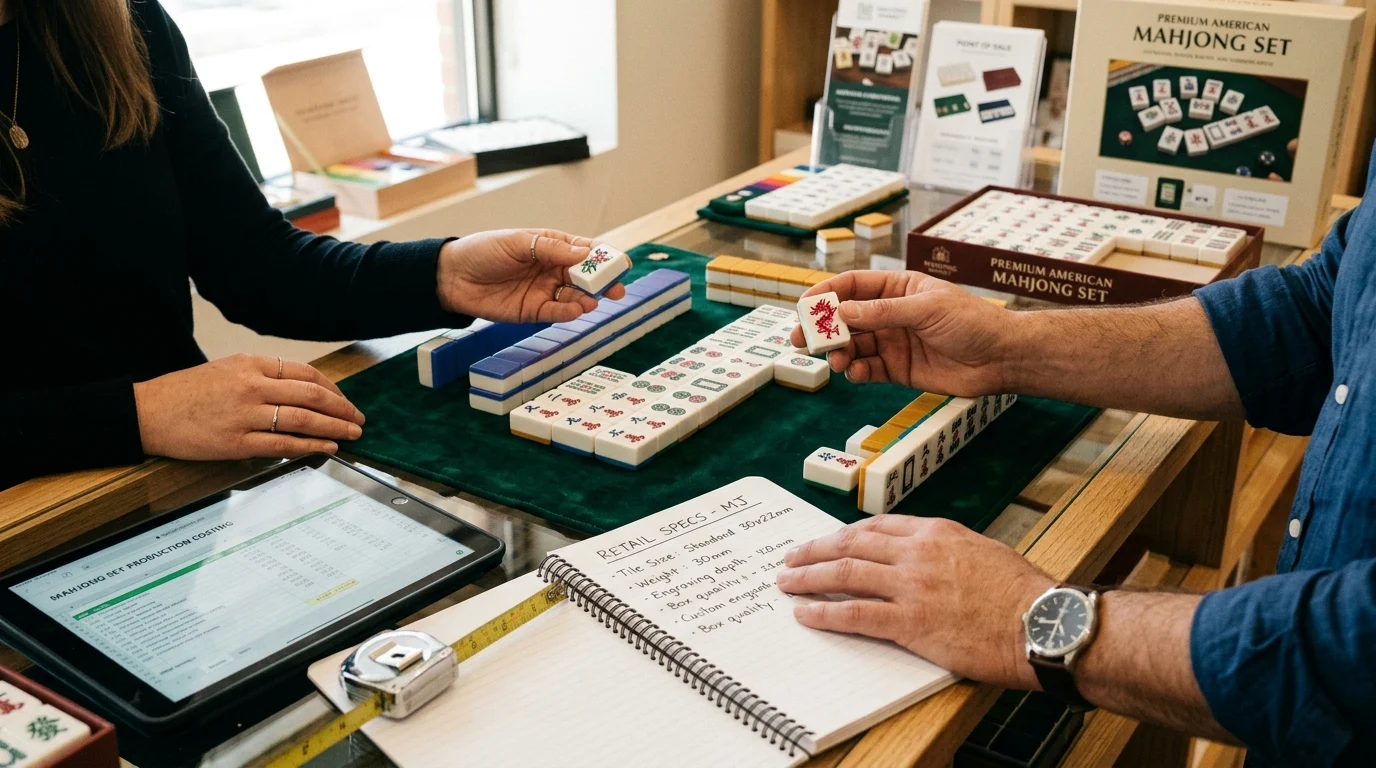
Defining the specifications that separate a professional, retail-ready American Mahjong Set from lower-tier variants is critical for procurement. A retail-ready product must strictly adhere to the structural and quantitative standards expected by active players while delivering a superior tactile experience.
Specifically, American Mahjong utilizes a distinct tile distribution and requires specific accessories not found in traditional Chinese or Japanese variants. Ensuring technical accuracy in these components prevents costly returns and protects the retailer’s reputation among experienced players.
Core components and material options
The core of any American set is the 166-tile configuration, which includes 152 standard tiles required by the National Mah Jongg League (NMJL), plus additional jokers and blank replacement tiles. The material composition of these Mahjong Tiles dictates both the manufacturing cost and the final retail positioning.
Melamine and acrylic are the two dominant materials in the premium sector. Melamine offers exceptional durability and a satisfying acoustic resonance, boasting a high density of approximately 1.5 g/cm³. Acrylic, while slightly less dense at 1.18 g/cm³, allows for transparent, translucent, and highly vibrant multi-layered color designs that appeal heavily to the modern lifestyle market.
Tile size, racks, pushers, and case specifications
Standard American tile dimensions typically measure 1-1/8 inches in height, 7/8 inches in width, and 1/2 inch in depth (approximately 30 x 22 x 13 mm). Deviating significantly from these dimensions can render the tiles incompatible with standard accessories. Racks must measure between 18 and 20 inches in length to accommodate the American hand, and integrated pushers are considered a mandatory feature for modern retail sets.
Case specifications also play a crucial role in retail readiness. While traditional sets utilize heavy aluminum flight cases, modern retail iterations increasingly favor vegan leather bags, canvas totes, or reinforced acrylic display boxes that reduce shipping weight and appeal to contemporary aesthetic sensibilities.
| Material Type | Density / Weight | Durability | Aesthetic Profile | Typical Retail Price Band |
|---|---|---|---|---|
| Standard Melamine | ~1.5 g/cm³ (Heavy) | Extremely High (Scratch resistant) | Traditional, opaque | $80 – $150 |
| Premium Acrylic | ~1.18 g/cm³ (Moderate) | High (Prone to micro-scratches) | Modern, translucent, vibrant | $150 – $350+ |
| Resin Composites | Variable | Moderate to High | Highly customizable, mixed-media | $200 – $400 |
Stock, semi-custom, and fully custom models
Retailers must choose between stock, semi-custom, and fully custom procurement models. Stock models require the lowest commitment but offer zero brand differentiation. Semi-custom models allow retailers to utilize existing tile molds while customizing the packaging, tile back colors, or adding a laser-engraved logo, usually requiring a Minimum Order Quantity (MOQ) of 200 to 300 units.
Fully custom models, which involve unique pantone matching, custom face artwork, and proprietary accessory molds, typically demand MOQs starting at 500 to 1,000 units. While the upfront capital requirement is higher, the fully custom route provides the exclusivity necessary to achieve maximum retail margins.
How to Evaluate Sourcing and Quality Control
Selecting a manufacturing partner for a premium Mahjong Tiles Set requires rigorous evaluation of supplier capabilities and quality assurance protocols. The tactile nature of the game means that even minor manufacturing defects are immediately noticeable to the end consumer.
Effective sourcing strategies involve verifying a factory’s technical infrastructure, understanding their quality control tolerances, and accurately modeling the landed costs before committing to bulk production.
Supplier capabilities and sampling process
Evaluating a supplier begins with assessing their injection molding precision and engraving capabilities. Premium sets require deep, clean engraving to hold paint without bleeding, or high-resolution UV printing that resists fading and chipping over years of gameplay.
The sampling process is the critical first step in risk mitigation. Retailers should expect a prototyping lead time of 14 to 21 days. During this phase, buyers must evaluate the physical weight, color accuracy against Pantone references, and the structural integrity of the accessories before signing off on the master sample.
Artwork control and production standards
Artwork control necessitates strict adherence to production standards. Suppliers must be capable of handling vector graphics with precise registration tolerances, typically requiring alignment accuracy within ±0.1mm. Any deviation beyond this tolerance results in off-center designs that degrade the product’s premium positioning.
Quality control (QC) standards must be explicitly defined in the purchasing contract. For high-end retail sets, the acceptable defect rate should be negotiated to under 1.5%. Pre-shipment inspections using the AQL (Acceptable Quality Limit) standard—usually AQL 2.5 for major defects and 4.0 for minor defects—ensure that production batches meet the approved sample specifications.
Key cost drivers and landed pricing
Understanding the key cost drivers is essential for accurate margin modeling. The primary variables include tooling costs, material selection, and the labor required for finishing. For example, creating a custom injection mold for a unique tile shape or proprietary pusher design can incur upfront tooling costs ranging from $3,000 to $5,000.
Landed pricing calculations must incorporate not only the ex-works (EXW) factory cost but also freight forwarding, customs duties, and domestic warehousing. Hand-painted intaglio tiles will drive up labor costs significantly compared to automated laser etching, directly impacting the final landed cost per unit.
| Production Variable | Low-End / Standard Approach | High-End / Premium Approach | Primary Cost Driver |
|---|---|---|---|
| Tile Artwork | Automated surface UV printing | Hand-painted deep intaglio engraving | Labor hours per set |
| Packaging | Standard corrugated cardboard | Vegan leather tote or acrylic display | Material and volumetric freight |
| Accessories | Generic plastic coin chips | Custom molded integrated pushers | Tooling and injection molds |
Compliance, Packaging, and Logistics Considerations
Navigating the regulatory and logistical framework is a non-negotiable aspect of bringing custom tabletop games to the retail market. Failure to comply with safety standards or poor packaging design can result in customs holds, damaged inventory, and significant financial losses.
Retail procurement teams must integrate compliance checks, packaging engineering, and freight planning into the early stages of the product development lifecycle to ensure a seamless transition from factory floor to retail shelf.
Product safety and labeling requirements
Although American Mahjong is predominantly an adult game, products entering the US market may still be subjected to stringent product safety testing if they possess crossover appeal or lack age-grading labels. Compliance with ASTM F963 standards and the Consumer Product Safety Improvement Act (CPSIA) is highly recommended as a baseline risk management strategy.
These regulations mandate rigorous testing for heavy metals and restricted plasticizers. Specifically, lead limits in surface coatings (such as the paint used in tile engravings) must not exceed 90 parts per million (ppm), and the concentration of eight specific phthalates in acrylic or plastic components must remain strictly under 0.1% (1,000 ppm). Securing third-party laboratory test reports prevents costly delays at the port of entry.
Packaging design and carton configuration
Packaging design must balance retail shelf impact with robust structural protection. Premium sets are dense and heavy, making them susceptible to damage during transit. The packaging must pass ISTA 1A drop testing protocols to ensure the internal components, particularly fragile Mahjong Accessories like acrylic racks, survive the journey.
Master carton configurations require careful calculation. To avoid specialized handling surcharges from domestic carriers and to comply with standard warehouse ergonomics, master cartons should be kept under a maximum weight of 15 kg (33 lbs). This typically limits a master carton to holding 3 to 4 individual sets, depending on the material density.
Freight, inventory, and delivery planning
Freight and inventory planning for these sets is heavily influenced by their weight-to-volume ratio. A standard, fully equipped set weighs roughly 3 to 4 kg (7 to 9 lbs) when boxed. Because of this high density, ocean freight is the only economically viable transportation method for bulk orders; air freight would erode retail margins entirely.
Delivery planning must account for container utilization. A standard 20-foot shipping container can hold approximately 2,500 to 3,000 boxed sets. Retailers must factor in ocean transit times of 4 to 6 weeks, plus port congestion buffers, ensuring that inventory arrives well ahead of peak holiday purchasing seasons.
How Retailers Can Choose the Right Custom Set

Strategic procurement of custom tabletop games requires retailers to align their product development with established brand identities and anticipated market demand. Choosing the right set is not merely a matter of finding the lowest cost supplier; it involves a holistic assessment of product fit, vendor reliability, and timeline management.
By structuring a disciplined procurement roadmap, retail buyers can mitigate the inherent risks of overseas manufacturing and successfully launch a product that resonates with their specific customer base.
Decision criteria for product fit
The decision criteria for product fit should begin with a thorough analysis of the retailer’s core demographic. A boutique catering to coastal, resort-town clientele might prioritize lightweight acrylic tiles with nautical or botanical motifs, whereas a traditional luxury department store may favor heavyweight melamine with classic, understated typography.
Retailers must also decide on the inclusion of supplementary items. Determining whether to include instructional rulebooks, premium scoring coins, or branded carrying bags can significantly alter both the perceived value and the final bill of materials. The chosen configuration must justify the targeted retail price point.
Supplier comparison and selection
Supplier comparison should extend beyond the initial price quote. Retailers should prioritize factories holding ISO 9001 certifications, which indicate formalized quality management systems. Evaluating a supplier’s communication responsiveness, English proficiency, and willingness to provide historical production references is critical for long-term partnerships.
Payment terms also serve as a vital comparison metric. Standard industry terms for custom manufacturing typically require a 30% deposit via telegraphic transfer (TT) to initiate tooling and raw material purchasing, with the remaining 70% balance due upon the issuance of the Bill of Lading, after successful third-party inspection.
Procurement roadmap from concept to launch
A successful procurement roadmap from concept to launch demands precise timeline planning. Retailers should allocate a total lead time of 12 to 16 weeks for a new custom American Mahjong Set. This includes 3 to 4 weeks for digital design and physical sampling, 4 to 6 weeks for bulk production, and 4 to 6 weeks for ocean freight and customs clearance.
By proactively managing this schedule, retailers ensure that marketing campaigns, product photography, and visual merchandising strategies are fully developed by the time the inventory reaches the distribution center, culminating in a highly profitable and well-executed retail launch.
Key Takeaways
- The most important conclusions and rationale for American Mahjong Set
- Specs, compliance, and risk checks worth validating before you commit
- Practical next steps and caveats readers can apply immediately
Frequently Asked Questions
What should a retail-ready American Mahjong set include?
A retail-ready set should include 166 tiles, 4 racks, 4 pushers, and a sturdy case. This helps meet player expectations and reduces returns.
Which material is better for custom American Mahjong sets?
Melamine suits retailers wanting durability and a classic feel. Acrylic is better for bold colors, layered designs, and modern lifestyle collections.
Why do custom American Mahjong sets offer better retail margins?
Exclusive designs reduce direct price comparison and support premium pricing. Many retailers position custom sets in the $250–$350 range for stronger margins.
What tile size works best for American Mahjong sets?
A common standard is about 30 x 22 x 13 mm. Keeping close to this size ensures compatibility with racks, pushers, and player expectations.
Can nbyisure.com help retailers customize American Mahjong sets?
Yes, NBYISURE offers custom American Mahjong set options for retail businesses, including design-focused styles, premium materials, and gift-box packaging.
Post time: May-20-2026