Introduction
For catering businesses that rely on high-output baking, oven efficiency affects far more than utility bills. Energy-efficient pizza ovens help reduce operating costs, support carbon-reduction goals, and maintain consistent performance during busy service periods. They also make it easier to respond to stricter environmental standards without sacrificing speed or food quality. This article explains why these ovens are becoming a practical investment for sustainable catering operations, what features most influence real-world efficiency, and how the right model can strengthen both day-to-day margins and long-term business resilience.
Why an Energy-Efficient Pizza Oven Is a Strategic Asset
The commercial catering sector is undergoing a profound structural shift driven by volatile utility markets and increasingly stringent environmental regulations. For high-volume food service operators, thermal processing equipment represents one of the largest single points of energy consumption. Specifically, high-temperature baking requires sustained thermal output, making the transition to highly efficient equipment a critical strategic imperative rather than a mere operational upgrade. Investing in advanced thermal technology mitigates exposure to fluctuating utility rates while positioning the enterprise to meet evolving corporate environmental directives.
A rigorous approach to Sustainability within commercial kitchens necessitates evaluating equipment not just on initial capital expenditure, but on long-term thermal performance. Modern high-efficiency baking units are engineered to decouple production capacity from linear energy consumption, allowing operators to scale output without proportional increases in overhead.
Impact of energy costs, carbon targets, and service demands
The intersection of rising energy costs, aggressive corporate carbon reduction targets, and unrelenting peak service demands creates a complex operational matrix for modern catering businesses. Commercial electricity rates have seen substantial volatility, frequently ranging between $0.15 and $0.28 per kilowatt-hour (kWh) depending on regional grid constraints and peak-demand surcharges. For an operation running thermal equipment 12 to 16 hours daily, inefficient heat generation translates directly into margin erosion. By upgrading to units optimized for thermal retention, operators can typically reduce daily energy consumption by 30% to 45%.
Simultaneously, scope 1 and scope 2 emissions reporting is becoming standard practice for enterprise-level hospitality groups. Equipment that minimizes fossil fuel combustion or maximizes electrical efficiency directly contributes to required carbon footprint reductions. Furthermore, modern high-efficiency units are designed to maintain internal ambient temperatures exceeding 400°C (750°F) even during continuous loading, ensuring that service demands during peak operational hours do not result in temperature drops or extended recovery times.
Best-fit operating environments
The strategic value of advanced thermal equipment is maximized when deployed in environments that leverage its specific engineering characteristics. High-volume pizzerias, centralized ghost kitchens, and institutional catering facilities represent the ideal operational environments. In these settings, the equipment is subjected to continuous thermal cycling, meaning the insulation and heat-recovery capabilities are fully utilized to maintain baseline temperatures.
For example, in a ghost kitchen environment processing upwards of 400 to 600 orders per day, the ambient heat rejected by inefficient equipment places immense strain on HVAC systems. High-efficiency units feature superior external thermal shielding, often keeping the exterior skin temperature below 40°C (104°F). This drastically reduces the ambient cooling load, yielding secondary energy savings by lowering the required tonnage and duty cycle of the facility’s air conditioning and ventilation infrastructure.
What Defines an Energy-Efficient Pizza Oven
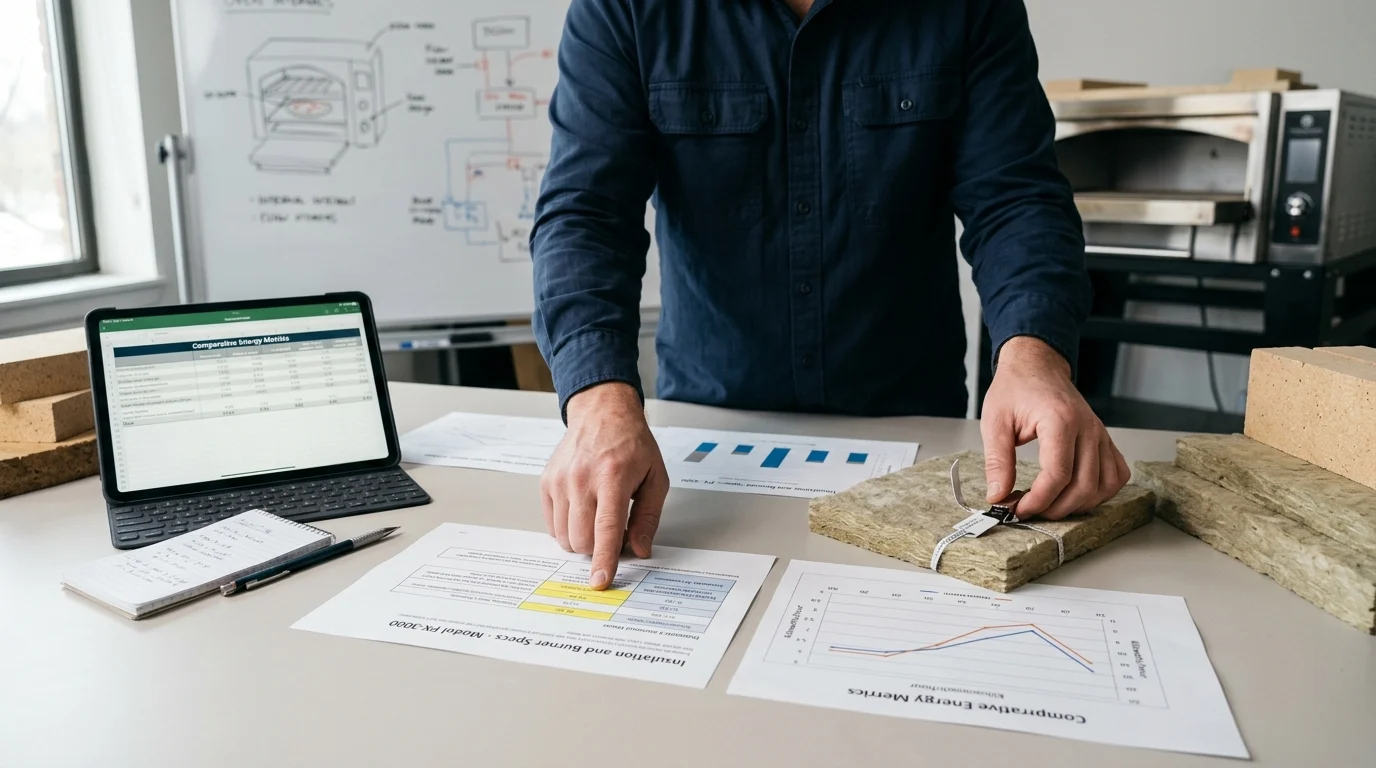
True energy efficiency in high-temperature baking is defined by a combination of thermodynamic principles: heat generation, thermal mass retention, and minimal standby loss. An Eco-Friendly baking unit is not merely one that uses an alternative fuel source, but one engineered to maximize the transfer of generated heat directly to the product while minimizing environmental dissipation. This requires a sophisticated integration of advanced refractory materials, precision airflow management, and intelligent thermostatic controls.
Core efficiency specifications
The foundational specification of an efficient unit is its insulation R-value and the density of its thermal mass. Premium commercial units typically utilize multi-layered ceramic fiber insulation combined with high-alumina refractory brick, resulting in an R-value exceeding 30. This structural design ensures that once the optimal baking temperature is achieved, the energy required to maintain it drops significantly.
Another critical metric is the standby energy consumption rate. A highly efficient commercial unit should draw less than 1.5 kW to maintain a 350°C idle temperature during off-peak hours. Furthermore, advanced proportional-integral-derivative (PID) controllers are utilized to modulate power delivery dynamically, utilizing solid-state relays to pulse energy exactly as needed rather than relying on inefficient binary on/off heating cycles.
Electric vs gas vs wood-fired vs hybrid ovens
Evaluating the core mechanism of heat generation requires comparing the thermodynamic profiles of electric, gas, wood-fired, and hybrid systems. Electric systems offer precise control and zero localized emissions, making them highly efficient at the point of use. Gas units provide rapid heat-up times and high baseline power, but suffer from combustion exhaust heat loss. Wood-fired units require significant skill and face regulatory scrutiny regarding particulate matter, while hybrid systems attempt to bridge these operational gaps.
| Fuel Type | Typical Thermal Efficiency | Average Heat-Up Time (to 400°C) | Standby Energy Cost (Relative) | Point-of-Use Emissions |
|---|---|---|---|---|
| Advanced Electric | 85% – 92% | 45 – 60 minutes | Low (< 1.5 kW) | Zero |
| Modulating Gas | 65% – 75% | 30 – 45 minutes | Moderate | CO2, NOx |
| Traditional Wood | 30% – 40% | 90 – 120 minutes | High (Continuous fuel) | High Particulate (PM2.5) |
| Hybrid (Gas/Wood) | 50% – 60% | 45 – 75 minutes | Moderate to High | Moderate Particulate |
Electric ovens equipped with independent top and bottom element control currently lead the market in quantifiable thermal efficiency. By eliminating the need for an open flue—which inevitably draws ambient air through the chamber and exhausts usable heat—electric models maintain a sealed thermal envelope, resulting in superior energy utilization per baking cycle.
Lifecycle cost comparison factors
A comprehensive lifecycle cost analysis must extend over a projected 7-to-10-year operational horizon. While the initial capital expenditure (CapEx) for a premium, high-efficiency unit may be 20% to 40% higher than a standard model, the operational expenditure (OpEx) savings rapidly offset this premium. The calculation must encompass direct fuel or electricity costs, preventative maintenance, and replacement parts.
For instance, a standard gas unit operating at 65% efficiency may consume $8,000 annually in fuel. Upgrading to an electric unit with 90% efficiency could reduce equivalent energy costs to $4,500 annually. Over a 10-year lifecycle, this $35,000 operational saving dramatically eclipses the initial $5,000 to $8,000 equipment premium, delivering a highly favorable internal rate of return (IRR) and a payback period often realized within the first 18 to 24 months of operation.
How to Evaluate Cost, Compliance, and Operational Fit
Navigating the procurement of a commercial Pizza Oven demands a holistic evaluation framework that balances financial metrics, stringent safety regulations, and the physical realities of the kitchen operation. Selecting equipment solely based on theoretical maximum output or lowest initial purchase price frequently leads to critical operational bottlenecks, compliance failures, and inflated long-term costs.
Key total cost of ownership drivers
The Total Cost of Ownership (TCO) for thermal processing equipment encapsulates far more than the invoice price and freight. Key drivers include the localized cost of the energy source, routine maintenance schedules, and the degradation curve of internal components such as refractory stones and heating elements. Operators must model TCO based on actual localized utility rates rather than national averages.
Additionally, a prudent TCO model incorporates a 15% to 20% buffer for hidden operational costs, including specialized cleaning chemicals, replacement of proprietary gaskets, and potential downtime. High-efficiency units often feature self-diagnostic software and modular component designs, which significantly reduce the mean time to repair (MTTR) and lower the lifetime reliance on expensive emergency technician dispatches.
Ventilation, fire safety, and emissions requirements
Regulatory compliance dictates significant infrastructure design, particularly regarding ventilation and fire suppression. In North America, solid-fuel and gas-fired equipment typically require a Type 1 commercial kitchen hood equipped with fire suppression (e.g., ANSUL systems) to comply with NFPA 96 and UL 710 standards. These hoods must extract air at high velocities, often requiring 800 to 1,200 cubic feet per minute (CFM) of exhaust capacity, which inherently pulls conditioned air out of the building.
Conversely, many advanced electric units are classified as ventless or require only a Type 2 heat-and-moisture hood, which operates at a significantly lower CFM (e.g., 200 to 400 CFM) and does not require integrated fire suppression. Furthermore, jurisdictions with strict environmental mandates are increasingly enforcing limits on PM2.5 particulate emissions, making traditional solid-fuel units unviable without the addition of expensive electrostatic precipitators or secondary water scrubbers.
Production volume, menu mix, and labor considerations
The equipment must geometrically and thermally align with the operation’s projected throughput, measured in pizzas per hour (PPH). A high-volume concept requiring 120 to 150 PPH during a Friday night peak demands a unit with rapid thermal recovery; otherwise, bake times will stretch from an optimal 90 seconds to over 3 minutes as the deck temperature crashes under continuous loading.
Labor considerations also play a critical role in equipment evaluation. Traditional units require highly skilled operators to manually rotate products and manage distinct temperature zones. Modern high-efficiency systems utilize rotating decks or highly engineered static heat mapping to eliminate cold spots. This allows operators to utilize lower-skilled labor for loading and unloading, reducing hourly wage dependencies and minimizing product waste caused by uneven baking.
How to Optimize Selection, Installation, and Daily Use
Realizing the theoretical benefits of high-efficiency equipment depends heavily on rigorous implementation methodologies. Even the most advanced thermal systems will underperform if subjected to improper commissioning, inadequate utility infrastructure, or flawed daily operational protocols. Optimizing Energy Saving capabilities requires a disciplined approach spanning from initial site preparation through to daily end-user interaction.
Procurement and commissioning best practices
Strategic procurement involves precise specification of site utilities well in advance of delivery. High-capacity electric units frequently require 3-phase, 400V/480V power infrastructure capable of delivering 32 to 63 amps per phase. Failure to verify electrical panel capacity prior to ordering can result in facility upgrade costs that severely disrupt the project budget and timeline. Standard supply chain lead times for commercial units currently range from 6 to 10 weeks, necessitating accurate project forecasting.
Commissioning must be executed by certified technicians who validate the calibration of internal thermocouples and ensure the unit’s software is updated to the latest firmware. A proper commissioning process includes a controlled ‘burn-in’ phase to cure the refractory materials slowly, preventing micro-fractures in the thermal mass that could compromise long-term heat retention and structural integrity.
Loading, preheat, and operating efficiency
Daily operational protocols directly dictate actualized energy expenditure. A common operational error is activating all heating zones simultaneously at maximum power hours before service. High-efficiency units should utilize staggered, programmable preheat schedules that bring the core temperature up gradually, typically over 45 to 60 minutes, which prevents demand-spike penalties from utility providers.
During service, operational discipline regarding door management is vital. Leaving the main baking chamber open unnecessarily can result in a localized temperature drop of up to 50°C (122°F) per minute. Efficient operation requires staff to batch-load products and utilize the oven’s internal thermal mapping, relying on the unit’s recovery algorithms rather than manually overriding temperature set-points, which often leads to energy-intensive temperature overshoot.
Supplier support, warranty, and training
The lifecycle performance of commercial baking equipment is intrinsically linked to the manufacturer’s post-sale ecosystem. Operators must evaluate the depth of the supplier’s support network, prioritizing vendors that offer guaranteed 24-to-48-hour service level agreements (SLAs) for critical component replacement. Standard commercial warranties should guarantee parts and labor for a minimum of 12 to 24 months, with extended coverage available for core components like electronic control boards and primary heating elements.
Furthermore, investing in comprehensive staff training yields a high return on investment. Training should not only cover basic operation but also focus on daily preventative maintenance, such as proper deck sweeping techniques to prevent carbon buildup, and the interpretation of onboard diagnostic codes. Well-trained staff are the primary defense against the gradual loss of efficiency caused by neglected maintenance and improper operational habits.
A Decision Framework for Choosing the Right Pizza Oven
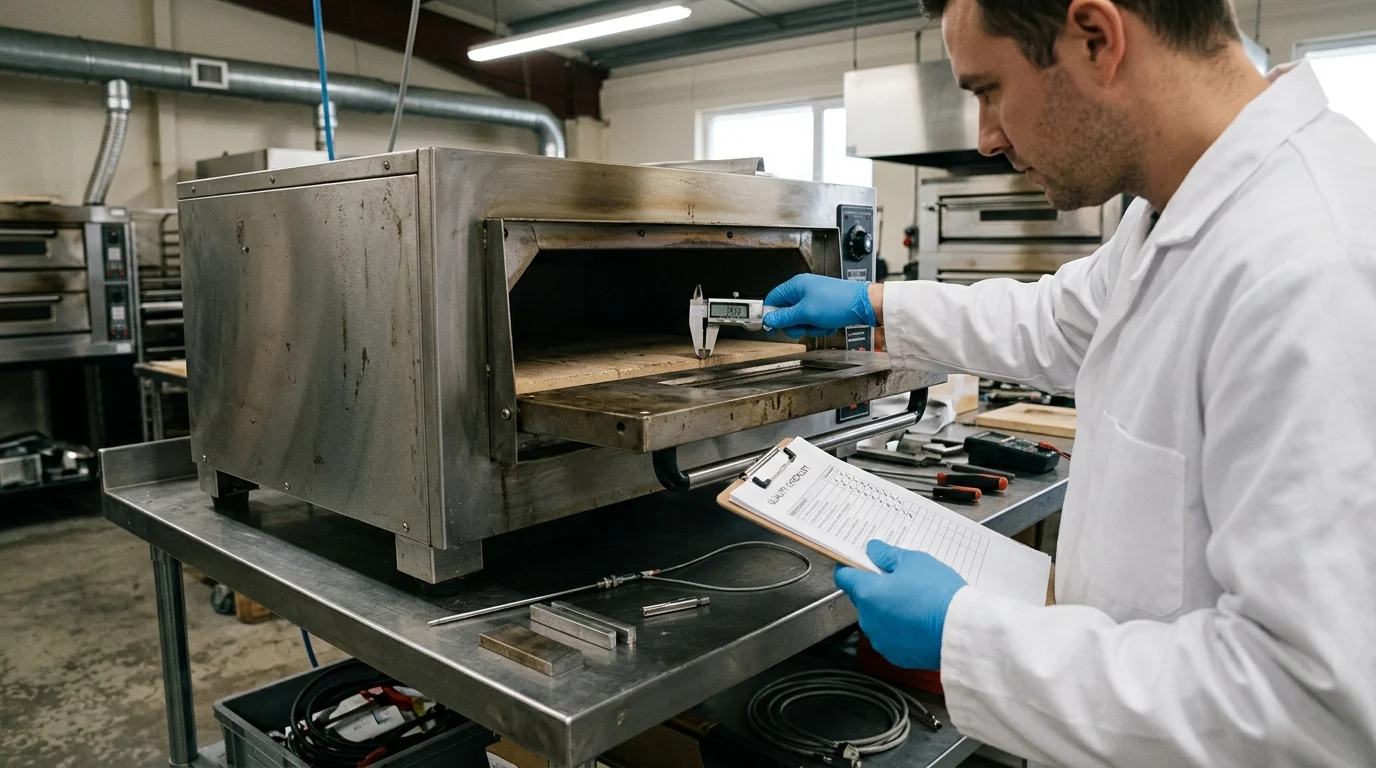
Establishing a rigorous procurement framework ensures alignment between capital expenditure, operational objectives, and environmental mandates. Selecting the optimal thermal platform for a Green Kitchen requires cross-referencing menu specifications with physical facility constraints and long-term financial modeling. By utilizing a structured decision matrix, catering businesses can eliminate subjective biases and focus on quantifiable performance metrics.
Matching oven type to business needs
The correlation between operational volume, available footprint, and equipment specifications dictates the ultimate selection. A matrix approach helps operators categorize their needs based on peak throughput and infrastructure limitations. High-volume operators prioritize thermal recovery and footprint density, while artisanal operators may prioritize specific baking atmospheres or aesthetic impact.
| Operational Profile | Peak Volume Target | Ideal Oven Architecture | Primary Evaluation Metric | Infrastructure Constraint |
|---|---|---|---|---|
| Enterprise Delivery | > 150 PPH | Conveyor / Multi-deck Electric | Thermal Recovery Rate | 3-Phase Power Availability |
| Artisanal Dine-in | 80 – 100 PPH | Static Dome (Electric/Gas) | Deck Heat Retention | Type 1 Hood Requirements |
| Ghost Kitchen | 100 – 120 PPH | Compact Multi-deck Electric | Output per Sq. Meter | HVAC Cooling Load |
| Mobile Catering | < 60 PPH | Lightweight Gas/Wood Hybrid | Heat-up Speed | Payload Weight Limits |
By mapping the business model to the architectural strengths of specific oven designs, operators ensure that they are not paying a premium for capabilities they will not utilize, nor are they under-specifying equipment that will bottleneck production during critical revenue-generating hours.
Final selection criteria
Final selection must synthesize payload capacity, physical footprint, and the calculated return on investment. A standard benchmark for high-efficiency commercial equipment is achieving a target ROI within 18 months through combined energy savings, reduced labor dependencies, and lower HVAC overhead. Decision-makers must also factor in a 15% to 20% capacity buffer to accommodate future menu expansion or volume growth without requiring immediate secondary equipment purchases.
Ultimately, the decision framework hinges on viewing the equipment not as a static asset, but as an active participant in the facility’s overall energy ecosystem. By prioritizing verifiable insulation metrics, intelligent power modulation, and regulatory compatibility, catering businesses can secure equipment that fortifies their operational margins while demonstrably advancing their enterprise sustainability objectives.
Key Takeaways
- The most important conclusions and rationale for Pizza Oven
- Specs, compliance, and risk checks worth validating before you commit
- Practical next steps and caveats readers can apply immediately
Frequently Asked Questions
What makes a pizza oven energy efficient?
Look for strong insulation, dense thermal mass, low standby draw under 1.5 kW at 350°C, and PID temperature controls for precise heat management.
How much energy can a sustainable catering business save with an efficient pizza oven?
Many commercial operators cut daily oven energy use by about 30% to 45%, especially in long-hour, high-volume kitchens.
Which catering setups benefit most from an energy-efficient pizza oven?
High-volume pizzerias, ghost kitchens, and institutional catering sites gain the most because they run ovens continuously and benefit from lower heat loss.
Can an efficient pizza oven also reduce kitchen cooling costs?
Yes. Better thermal shielding lowers heat released into the kitchen, which can reduce HVAC workload and improve staff comfort during peak service.
Where can I compare commercial pizza oven options for my business?
You can review commercial pizza oven solutions on nbyisure.com to compare models suited for sustainable, high-output catering operations.
Post time: May-08-2026