
In high-volume foodservice, seasoning is no longer a small detail—it is part of the production clock. Restaurants and delivery-only kitchens may process hundreds of orders per shift while delivery platforms compress prep times into tight 5- to 8-minute windows. That pressure forces operators to evaluate even simple tools, including pepper grinders, through the lens of speed, durability, sanitation, and consistency. This article looks at how commercial pepper grinders differ from household mills, when fresh-ground pepper is worth the operational cost, and which specifications matter most for restaurants, shared kitchens, and ghost kitchen teams trying to improve throughput without compromising flavor.
Commercial Pepper Grinders in Restaurants and Ghost Kitchens
The rapid evolution of the foodservice industry requires equipment that can keep pace with unprecedented order volumes (often exceeding 200–400 orders per shift). As culinary operations shift toward highly optimized, delivery-centric models—particularly ghost kitchens—every second of food preparation is scrutinized. Without a front-of-house to buffer wait times, strict delivery-platform timing windows (typically demanding 5- to 8-minute prep times) dictate the pace of the kitchen. In this high-stakes environment, even seemingly minor tools must deliver maximum efficiency to maintain profitability.
What Defines a Commercial Pepper Grinder
A restaurant pepper grinder differs from a residential model in its material construction and output capabilities. While consumer models process small amounts of spice per meal, commercial units are engineered for continuous strain. These grinders utilize high-carbon steel or advanced ceramic burrs designed to withstand rigorous grinding cycles (often rated for 50,000 to 100,000+ revolutions) before showing measurable signs of degradation. Furthermore, commercial housings are typically constructed from high-gauge (e.g., 18/8 or 304-grade) stainless steel or impact-resistant polymers. These materials are chosen to withstand physical abuse and high ambient heat. However, operators must balance this durability with sanitation complexity; electric units require careful, moisture-free cleaning protocols to protect internal circuitry. Operators must also verify that any purchased equipment carries actual NSF (specifically NSF/ANSI Standard 2 for food equipment) or equivalent certifications, as not all models independently meet professional compliance standards.
How Restaurant and Ghost Kitchen Needs Differ
Traditional restaurants and ghost kitchens share identical back-of-house constraints, but their overall operational frameworks drive different equipment requirements. In a conventional restaurant setting, front-of-house operations often demand visually appealing, manual wooden or acrylic mills for tableside service. Conversely, ghost kitchens face unique constraints such as shared-kitchen spatial density, extreme labor specialization, and the complete absence of front-of-house service.
It is important to note that most high-volume commercial kitchens default to pre-ground pepper for bulk speed and cost efficiency. However, pre-ground spices rapidly lose their volatile flavor compounds. Fresh-ground pepper justifies the operational overhead—and becomes indispensable—when specific premium menu items, such as high-end steaks, finishing salads, or signature sauces, demand a distinct, robust flavor profile. When fresh grinding is required in these scenarios, it cannot become a bottleneck. High-capacity electric models allow line cooks to season dishes continuously, saving a crucial 3 to 5 seconds per dish that compound into significant labor savings (up to 30–40 minutes per shift) over hundreds of orders. Additionally, dense shared kitchens must consider equipment noise levels, favoring quieter motors operating below 65 decibels that do not add to the chaotic acoustic environment.
Key Specifications That Improve Prep Efficiency
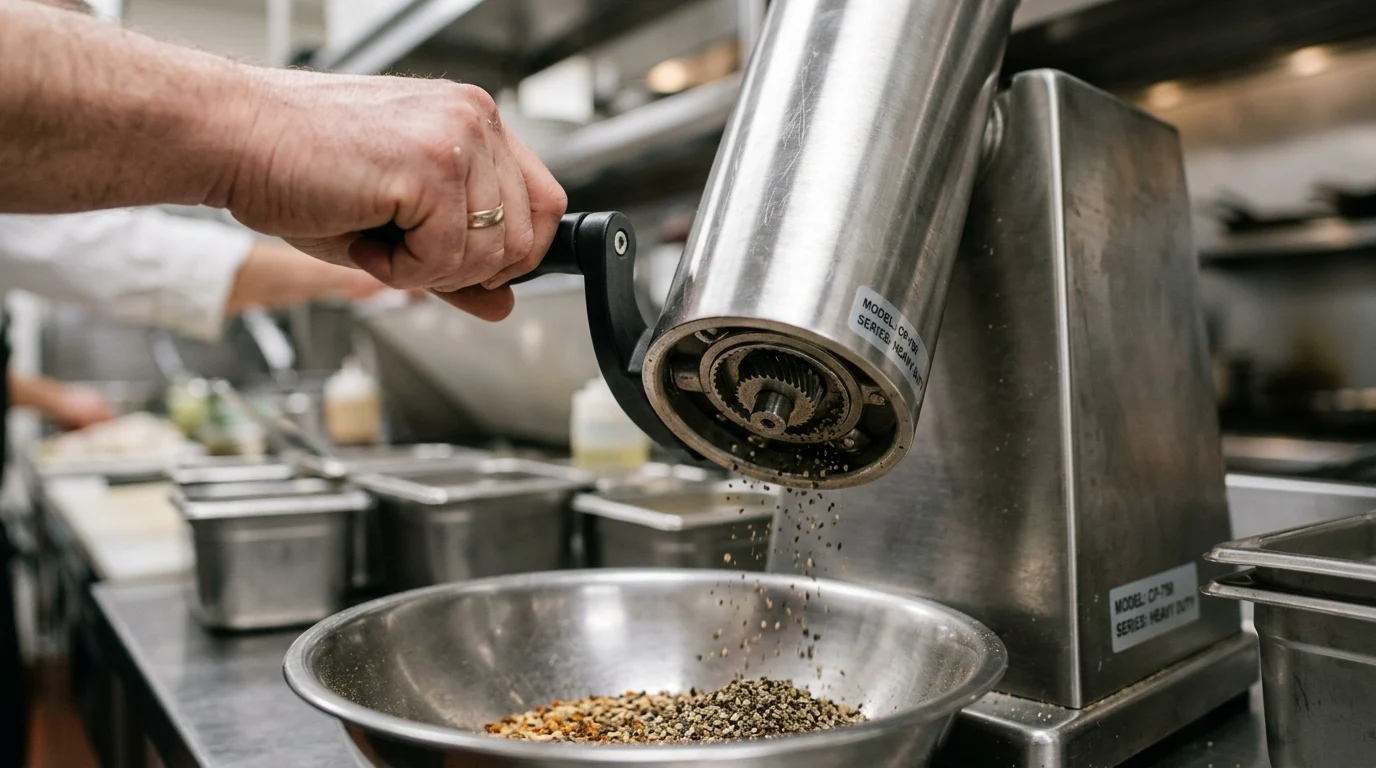
To achieve optimal prep efficiency, culinary operators must evaluate spice grinders based on strict technical specifications and commercial durability standards rather than cosmetic appeal. The right hardware configuration significantly reduces active labor time, minimizes cleaning downtime, and prevents equipment failure during peak service hours.
Manual vs Electric vs Battery-Powered Grinders
The choice between manual, electric, and battery-powered units directly impacts a kitchen's operational flow. Manual grinders offer exceptional reliability and precise tactile feedback but require two hands, creating a bottleneck during high-volume plating. An automatic pepper grinder eliminates this friction by enabling single-handed operation, allowing cooks to manipulate pans or plate components simultaneously.
| Grinder Type | Power Source | Operation | Best Use Case | Typical Output Speed |
|---|---|---|---|---|
| Manual | None | Two-handed | Tableside service | 1–2 grams/minute |
| Battery-Powered | 4–6 AA/AAA Dry Cells | One-handed | Low-volume prep | 3–5 grams/minute |
| Rechargeable Electric | 3.7V Lithium-ion | One-handed | High-volume prep | 5–8+ grams/minute |
For continuous commercial use, a foodservice pepper grinder equipped with a rechargeable lithium-ion battery is often preferred over units relying on disposable dry cells, as it provides consistent motor torque even as the charge depletes. However, operators must account for the total cost of ownership and potential failure points of rechargeable fleets. These caveats include the need for dedicated charging infrastructure, cable management at prep stations, and eventual battery degradation over time (typically requiring replacement after 300–500 charge cycles). Kitchens must establish downtime protocols—such as keeping backup manual mills or fully charged swap-out units—to ensure a dead unit does not halt service mid-shift.
Speed, Grind Consistency, Capacity, and Durability
Beyond power sources, efficiency is dictated by a combination of hopper capacity, grind consistency, and physical resilience. Commercial kitchens require extended-capacity hoppers (typically holding 150 to 250 grams, or 5 to 8 ounces, of peppercorns) to effectively reduce mid-shift refill frequency by up to 60% compared to standard 2-ounce residential units. Grind consistency is equally vital; high-quality ceramic burrs ensure that particle sizes remain uniform, which is critical for maintaining standardized recipe flavor profiles across multiple franchise locations. Durability metrics, such as drop-test ratings from 3 to 5 feet and IPX4-rated moisture-sealed internal compartments to prevent spice clumping in high-humidity environments (60%+ RH), are mandatory specifications. Operators should also look for designs that allow for rapid disassembly to minimize downtime during mandatory sanitization cycles.
How Operators Should Select and Deploy Grinders
Strategic deployment of kitchen equipment requires aligning the hardware's capabilities with the facility's daily order volume, food-safety codes, and long-term financial goals. Ad hoc purchasing based on superficial features rather than genuine commercial durability often leads to operational bottlenecks and inflated replacement costs over the fiscal year.
Matching Grinder Choice to Menu Volume
When sourcing restaurant supply pepper mills, operators must match the tool to the menu's demands. A kitchen specializing in heavily seasoned proteins that processes 300+ continuous orders daily will quickly destroy consumer-grade equipment. These high-volume operators benefit from purchasing commercial pepper grinder wholesale lots that meet professional kitchen codes. Establishing a wholesale relationship often involves Minimum Order Quantities (MOQs), typically ranging from 50 to 500 units. Buying at this scale allows franchise networks and multi-brand ghost kitchens to standardize their prep stations across dozens of locations while simultaneously reducing per-unit capital expenditure by 15% to 30%.
Key Takeaways
- Choose high-capacity electric grinders when fresh pepper is required, because saving 3–5 seconds per dish can recover up to 30–40 minutes per shift.
- Verify NSF/ANSI Standard 2 or equivalent food-equipment certification before buying grinders for professional restaurant or ghost kitchen use.
- Prioritize ceramic or high-carbon steel burrs rated for heavy grinding cycles to reduce performance loss during peak service.
- Use pre-ground pepper for bulk speed, but reserve fresh grinding for premium menu items where aroma and volatile flavor compounds justify the added step.
- Select quieter motors below 65 decibels for shared kitchens to avoid adding unnecessary noise to already crowded production environments.
Frequently Asked Questions
Why do ghost kitchens need faster pepper grinding?
Ghost kitchens often work within 5- to 8-minute delivery prep windows and may handle 200–400 orders per shift, so even small seasoning delays can reduce throughput.
Are electric pepper grinders better for commercial kitchens?
Electric models can save 3–5 seconds per dish when fresh pepper is required, which may add up to 30–40 minutes saved over a busy shift.
What materials should a commercial pepper grinder use?
Look for durable burrs made from high-carbon steel or advanced ceramic, plus housings made from 304-grade stainless steel or impact-resistant polymers.
Should restaurants always use fresh-ground pepper?
Not always. Many high-volume kitchens use pre-ground pepper for speed, but fresh-ground pepper is valuable for premium dishes, finishing applications, and signature sauces.
What certification matters for foodservice pepper grinders?
Operators should verify real NSF or equivalent compliance, especially NSF/ANSI Standard 2 for food equipment, rather than relying only on marketing claims.
Post time: Sep-10-2026